

The question “is IPTV legal?” comes up constantly in Canada, especially as cord-cutting accelerates and entrepreneurs explore reseller opportunities. In this post, we provide a detailed analysis of IPTV legality in Canada. The short answer: IPTV technology is completely legal. What makes a service legal or illegal comes down to one thing—content licensing. This guide breaks down exactly how Canadian law applies to IPTV, what separates legitimate providers from pirate operations, and what resellers need to know before building a business.
Key Takeaways
IPTV technology is legal worldwide. A service becomes illegal only when it distributes copyrighted content without proper licenses.
In Canada, legal IPTV must comply with CRTC regulations and the Copyright Act. Services selling “$10 for everything” packages are almost certainly operating illegally.
Both end-users and operators of illegal IPTV platforms can face legal consequences, though enforcement focuses primarily on operators and large-scale resellers.
Reselling unlicensed IPTV streams is copyright infringement—the “reseller” label provides no legal protection.
IPTVReseller.ca provides white-label infrastructure and tools; resellers remain responsible for operating only in markets where they comply with local law.
What Is IPTV (and How Is It Different from OTT Apps)?
Internet Protocol Television delivers live TV channels, movies, video on demand, and catch-up content over your internet connection rather than through traditional cable or satellite infrastructure. Where legacy cable bundles require dedicated coaxial wiring and satellite dishes need clear sky access, IPTV streams everything through your existing broadband. Most legal IPTV services are provided by telecom companies or independent internet service providers.
IPTV stands for Internet Protocol Television. The technology encodes video into IP packets and transmits them via managed or unmanaged networks. Most legal IPTV services use IP multicasting for live channels, efficiently distributing data to many households simultaneously while adaptive bitrate streaming adjusts quality based on your connection speed. IPTV services are generally provided by your internet provider, who will set you up with a streaming box to access IPTV channels.
Common devices for IPTV include:
Smart TV apps (Samsung, LG, Android TV)
Amazon Firestick and Fire TV
Android and iOS smartphones and tablets
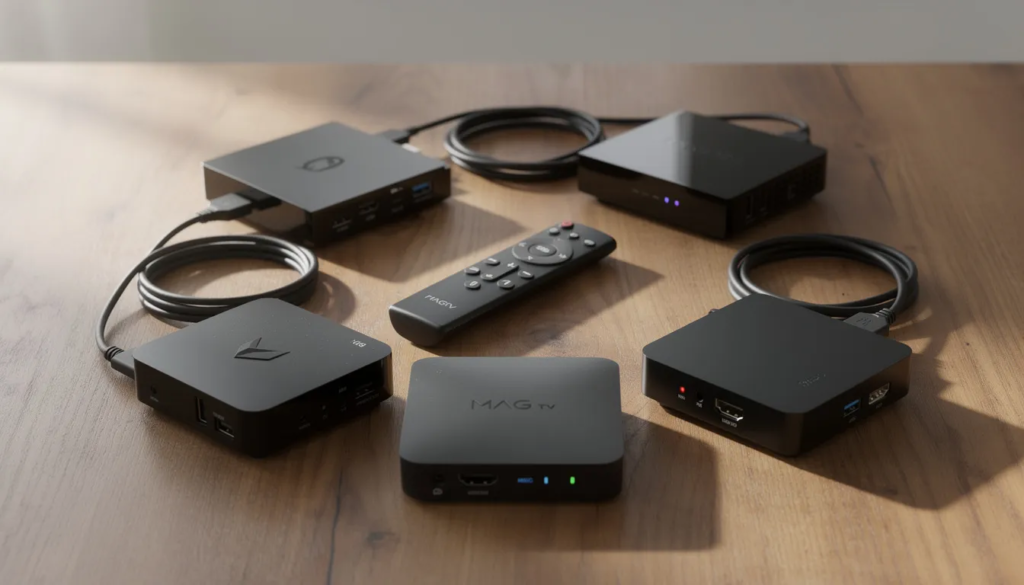
MAG boxes and other dedicated streaming box hardware
Windows and Mac desktop players
The distinction between IPTV and an OTT service like Netflix, Prime Video, or Disney+ matters. OTT services deliver on-demand libraries, including movies and TV shows, over the internet and are accessible on a wide range of devices. IPTV emphasizes live linear channels with electronic program guides, replicating the regular TV experience but delivered over the internet.
Canadian examples of licensed IPTV and OTT services include Bell Fibe TV, Rogers Ignite TV, VMedia, and Fubo TV. These operate as Broadcasting Distribution Undertakings (BDUs) under CRTC oversight, holding agreements with content owners to distribute their channels legally.
The technology itself is neutral. IPTV is just a delivery method. Legality depends entirely on whether the provider has secured rights to the content it distributes.
Is IPTV Legal? (Short, Direct Answer)
IPTV is legal in Canada, the US, UK, EU, and most other countries when the provider holds proper rights to the channels and content it distributes. The technology has been used by major telecoms for decades—AT&T, Comcast, Bell, and Rogers all integrate IPTV into their fiber services.
The legal principle is straightforward: copyright owners control who can distribute their content. To legally offer tv channels via IPTV, a provider must obtain broadcast or streaming licenses from networks, studios, and sports leagues. This involves paying retransmission fees and operating under contractual terms.
Legal IPTV services:
Licensed and transparent about their operating entity
Priced similarly to other pay-TV options ($40–$100/month)
Available through official app stores or established platforms
Provide clear terms of service and privacy policies
Illegal IPTV services:
Sell access to premium channels and PPV events without rights
Offer “all channels worldwide” for $10–$20/month
Operate anonymously through Telegram groups or constantly-changing domains
Accept only cryptocurrency or untraceable payment methods
There is no genuine “gray area” here. Feeds are either licensed or they are not. Using or reselling unlicensed streams constitutes copyright infringement under Canadian law and international treaties like the Berne Convention.
Enforcement priorities differ: operators and resellers of illegal IPTV platforms carry the highest legal risk. End-users are occasionally targeted, particularly in Europe, but most resources focus on shutting down the supply side.

IPTV Legality in Canada
Canadian IPTV must comply with the Broadcasting Act, the Copyright Act, and CRTC regulations. These frameworks govern how tv service is distributed to Canadian households, regardless of whether delivery happens via cable, satellite, or internet protocol.
Licensed IPTV providers in Canada operate as BDUs. They obtain agreements from rights-holders—Canadian networks, US channels, sports leagues, and studios—paying for the privilege to retransmit that content to subscribers. This licensing process involves significant cost and regulatory oversight. IPTV services typically vary based on the number of channels they offer or if they include any premium channels in their plans, giving consumers flexibility to choose the right package for their needs.
Legal Canadian IPTV and OTT examples:
Provider | Type | Key Features |
|---|---|---|
Bell Fibe TV | IPTV | Full channel lineup, 4K, integrated with Bell internet |
Rogers Ignite TV | IPTV | Voice control, cloud DVR, bundled with Rogers services |
Telus Optik TV | IPTV | Customizable packages, mobile viewing |
VMedia TV | IPTV | Lower-cost skinny bundles, à la carte options, package starting at $19.95 per month for many channels |
FuboTV Canada | OTT/IPTV | Sports-focused, 200+ channels |
“Back-alley” IPTV operations—those selling through random websites, Telegram channels, or Discord servers—that restream TSN, Sportsnet, Crave, US networks, and PPV without agreements are unambiguously illegal.
Since 2015, Canadian ISPs can forward infringement notices from rights-holders to subscribers. The 2019 Copyright Modernization Act reforms limited cash-demand letters in those notices but did not eliminate the possibility of lawsuits for serious infringement.
IPTV offers more choices and lower costs compared to traditional cable services. IPTV services often bundle better with internet plans, making them more cost-effective than cable.
Risks for Canadians using pirate IPTV:
Sudden service shutdowns with no refunds when authorities act
Potential civil claims from rights-holders in serious or repeat cases
Exposure of payment and personal data to offshore operators with no accountability
For Canadian entrepreneurs, the path forward is clear: build businesses around infrastructure that can be deployed compliantly in permitted markets rather than chasing short-term profits from unlicensed streams.
How IPTV Law Works in Other Major Regions
Broadcasting and copyright laws vary by country, but most jurisdictions focus on the same core issue: unauthorized retransmission of tv channels and premium content.
United Kingdom
The Digital Economy Act 2017 established strong penalties for commercial-scale piracy in the UK. Operators of illegal IPTV services face up to 10 years imprisonment. Recent years have seen aggressive enforcement, with police raids dismantling major IPTV rings and ISPs blocking access to known pirate domains.
UK users are not immune either. In 2024, rights-holders pursued cases against end-users, with some receiving warning letters and demands for settlement payments.
United States
The Protecting Lawful Streaming Act (2020), codified in 18 U.S.C. § 2319C, made large-scale illegal streaming operations a felony. Operators face up to 10 years imprisonment and fines up to $250,000. The Alliance for Creativity and Entertainment (ACE) has coordinated over 300 shutdowns since 2020.
DISH Network’s 2018 lawsuit against SET TV resulted in a $90 million judgment. The Mobdro developer faced arrest in 2019. Major ISPs like Comcast and Verizon actively block known pirate domains.
Legal iptv services in the US include YouTube TV (8 million subscribers), FuboTV (1.5 million subscribers), Sling TV, Hulu + Live TV, and free ad-supported options like Pluto TV and XUMO.
European Union (Germany Example)
Germany takes a particularly aggressive stance. Licensed platforms like MagentaTV, Zattoo, and Waipu.tv operate fully legally under German broadcasting law. Courts have handed prison sentences to pirate IPTV operators, with notable cases in 2024 signaling zero tolerance.
The 2024 Swedish crackdown made international news, with fines up to €700 per household impacting over 700,000 users of illegal IPTV services.
Middle East and Asia
UAE: IPTV is legal with proper licenses. Dubai courts have imposed heavy fines and jail terms for illegal restreaming operations. The regulatory environment is strict.
India: Legal IPTV must follow TRAI (Telecom Regulatory Authority of India) and MIB (Ministry of Information and Broadcasting) rules. Platforms like JioTV and Airtel Xstream demonstrate how regulated IPTV can operate at massive scale.
Key takeaway for resellers: Always verify the laws of the specific country where you market subscriptions. Server location does not determine legality—the jurisdiction where you sell and where your customers reside matters most.
Legal vs Illegal IPTV: How to Tell the Difference
Most confusion stems from unverified “all-in-one” IPTV sellers offering impossibly cheap access to thousands of premium channels. Distinguishing legitimate services from pirate operations requires attention to specific warning signs. Always verify that you are using a reputable site to access IPTV services and information, as legitimate providers typically offer clear service terms and reliable customer support. Canadians are increasingly demanding clearer service terms and better customer support from IPTV providers, making it even more important to choose a trustworthy site.
Warning Signs of Illegal IPTV
Hundreds or thousands of premium channels, international sports, and PPV for $10–$20/month or “lifetime” access
Payment only via cryptocurrency, gift cards, or transfers to personal accounts
No physical address, no legal entity name, no verifiable contact details
Sales and support handled exclusively through Telegram, WhatsApp, Discord, or Facebook groups
Domains that frequently change or disappear
Marketing that emphasizes circumventing geo-restrictions or accessing “all paid content free”
Studies indicate that approximately 40% of unverified IPTV apps bundle trojans or malware designed to steal credentials and payment information.
Signs of Legal IPTV or OTT Services
Clear brand identity with a registered corporate entity and verifiable address
Proper billing with receipts, tax entries, and standard payment methods (credit cards, PayPal, Interac)
Transparent terms of service and privacy policies referencing applicable law
Real customer support (ticket systems, email, phone, live chat) and stable domains
Available through official app stores (Google Play, Apple App Store, Amazon Appstore)
Pricing that reflects actual content licensing costs
“Free IPTV lists” scraped from the web or provided by random Kodi add-ons or Android apps almost never have distribution rights. Treat them as pirated unless you can verify explicit licensing.
When in doubt, check whether the provider is recognized by broadcasters or telecom regulators in your country. In Canada, that means looking for CRTC-registered BDUs or services with clear licensing partnerships.
Risks of Using or Selling Illegal IPTV
The low subscription price of pirate IPTV conceals significant legal, financial, and security risks that make it a poor choice for both viewers and entrepreneurs.
Risks for End-Users
Risk Category | Consequence |
|---|---|
Service reliability | Constant buffering, broken EPG, missing or unstable live channels |
Sudden shutdown | Loss of prepaid subscription when authorities or rights-holders act |
No refunds | Operators disappear overnight with no recourse |
Data exposure | Credit card info mishandled or sold; 40% of pirate apps contain malware |
Legal exposure | Warning letters, potential civil claims in serious cases |
Pirate services experience approximately 50% shutdown rates within six months. Many households lose access repeatedly, cycling through providers with increasing frustration.
Risks for Operators and Resellers
The stakes are dramatically higher for those on the supply side:
Civil lawsuits: Major broadcasters, leagues, and studios pursue distributors aggressively. DISH Network’s $90 million judgment against SET TV demonstrates the potential scale.
Criminal prosecution: The 2020 Felony Streaming Bill means US-connected operations face up to 10 years imprisonment. Similar penalties exist in the UK, Germany, and other jurisdictions.
Infrastructure collapse: Domain seizures, payment processor bans, and asset freezes can destroy a business overnight.
Brand destruction: You cannot build a legitimate, bankable business on illegal streams. Mainstream payment gateways will ban you once flagged.
ISPs and regulators cooperate with rights-holders across borders to identify large-scale piracy networks. ACE alone coordinates 100+ global enforcement actions yearly.
Building a business on illegal IPTV is fundamentally unsustainable. The question is not whether it will fail, but when. Serious entrepreneurs should focus on compliant markets and white-label infrastructure that supports legitimate operations.
Is IPTV Legal for Resellers? (B2B Perspective)
For Canadian entrepreneurs considering the IPTV reseller business model, understanding the legal chain is critical. The “reseller” designation provides no legal shield whatsoever.
The legal reality: If the underlying service distributes content without proper licenses, reselling it is also illegal. You become part of an infringing distribution chain, even if you never touch the actual streams yourself.
The Legitimate Content Distribution Chain
Content owners (channels, studios, sports leagues) create and hold rights
Licensed platforms negotiate and pay for distribution rights
Authorized resellers operate under contracts that respect those rights
Breaking any link in this chain creates liability for everyone downstream.
What Legitimate Resellers Should Verify
Before partnering with any upstream provider:
Location and incorporation: Where is the provider legally registered? Can you verify this independently?
Licensing documentation: What evidence exists that they hold distribution rights? Are they permitted to have sub-resellers in your target region?
Permitted use cases: Are there geographic restrictions? Residential vs. commercial limitations? Device type requirements?
Compliance history: How long have they operated? Any history of enforcement actions or domain seizures?
Infrastructure vs. Content Providers
Providers like IPTVReseller.ca position themselves differently in this ecosystem. The focus is on white-label dashboards, credit systems, and high-performance servers—infrastructure that enables reseller businesses rather than content distribution itself.
This distinction matters because infrastructure providers do not claim to override local law. Resellers using such platforms remain fully responsible for the legality of whatever streams they choose to sell in their specific jurisdiction.
Bottom line: Consult a lawyer familiar with broadcasting and IP law in Canada (or your local country) before scaling any IPTV reseller operation. The investment in proper legal guidance is trivial compared to the cost of getting it wrong.
How IPTVReseller.ca Fits Into the Legal Landscape
IPTVReseller.ca operates as a Canadian-owned B2B provider of white-label IPTV infrastructure. The business model is distinct from content providers or pirate operations.
What IPTVReseller.ca Actually Offers
Feature | Description |
|---|---|
Wholesale Credits | Packages (120, 360, 600, 1200 credits) to allocate to end-user subscriptions |
Reseller Panel | Dashboard for managing accounts, trials, renewals, and devices |
Server Infrastructure | High-performance servers with 4K support and optimized streaming quality |
White-Label Branding | Resellers sell under their own brand, not ours |
Device Compatibility | Support for Smart TV apps, Firestick, Android, iOS, MAG boxes, Windows/Mac |
Support | 24/7 monitoring and customer support |
This infrastructure model supports legal compliance by emphasizing transparent, long-term business operations rather than disposable fly-by-night domains. The tools make it easy for serious resellers to manage customer bases professionally.
Reseller Responsibilities
Using IPTVReseller.ca does not transfer legal responsibility. Resellers remain accountable for:
Operating only in regions where their specific content offerings comply with local broadcasting and copyright rules
Setting clear terms with their own customers
Being transparent about what they are selling
Maintaining proper business records and tax compliance
Benefits for Legitimate Resellers
Entrepreneurs building compliant operations care about:
Reliability: 24/7 support and monitoring to maintain uptime
Performance: Reliable internet delivery with minimal buffering
Flexibility: Compatibility with devices customers already own
Profitability: Demonstrated potential margins when operating a well-managed IPTV brand
Scalability: Unlimited free trials to onboard customers before commitment

How to Choose a Compliant IPTV Provider or Reseller Platform
Choosing the right upstream provider or infrastructure partner determines whether you stay on the right side of the law. Both viewers and entrepreneurs need systematic approaches. Legal IPTV providers often offer affordable options compared to traditional cable, making them attractive for budget-conscious consumers.
When selecting a provider, consider that IPTV provides a more flexible viewing experience, allowing users to curate their channel lists. Many legal IPTV services also allow users to customize their channel packages based on preferences and budget, ensuring you only pay for what you want to watch.
For Viewers Choosing a Personal IPTV Subscription
Check reputation: Is the provider discussed positively on established review sites without obvious piracy associations?
Evaluate pricing: Does it seem realistic compared to cable or other legal options? Suspiciously cheap usually means unlicensed.
Verify support: Look for clear customer support channels, refund policies, and legal documentation.
Confirm accessibility: Is the app available through official app stores, or must you sideload from random websites?
Test reliability: Most legal iptv services offer trials. Use them to verify streaming quality and channel stability.
For Entrepreneurs Selecting a Reseller Platform
Evaluate stability: Is the platform well-documented and based in a jurisdiction with clear regulation (like Canada)?
Test before committing: Use free trials to verify panel functionality, EPG quality, and channel reliability.
Ask direct questions: What are the uptime guarantees? Server redundancy? Long-term support commitments?
Verify the business: Can you find information about the company beyond a single landing page?
Review terms: Are the reseller agreements clear about responsibilities and permitted uses?
Red Flags to Avoid (Both Audiences)
Provider refuses to discuss basic company details
Marketing emphasizes using VPNs purely to “stay under the radar”
Primary selling point is “all paid content for free” or “everything for $10”
Support only available through anonymous messaging apps
Domains change frequently or use unusual TLDs
Anyone planning a larger-scale reseller operation should seek independent legal advice tailored to their specific market. Regulations continue to evolve, and what applies today may change tomorrow.

Is IPTV Legal? Conclusion
IPTV is legal in Canada and most other countries when the service has proper content licenses and respects broadcasting and copyright law. The technology itself has never been the issue—internet protocol television is simply a delivery method used by major telecoms worldwide.
The distinction that matters:
Legitimate IPTV and OTT platforms operate transparently, charge sustainable prices reflecting actual licensing costs, and provide reliable providers with real customer support.
Illegal IPTV services rely on unauthorized restreaming, impossibly low pricing, and anonymity. They get shut down frequently, expose users to legal trouble and security risks, and offer no foundation for a sustainable business.
Using or reselling illegal IPTV exposes everyone involved to legal, financial, and security risks while undermining any possibility of building a legitimate long-term operation.
For Canadian entrepreneurs who want to build scalable, brandable IPTV businesses while taking legal compliance seriously, infrastructure partners like IPTVReseller.ca provide the white-label tools, high-performance servers, and support needed to operate professionally in permitted markets.
The choice is clear: use only compliant IPTV services for personal viewing, and if you’re building a business, invest in transparent, high-quality platforms rather than short-lived pirate offerings that will inevitably collapse.
FAQs
Do I personally get in trouble for using an illegal IPTV service?
Enforcement in most countries focuses primarily on operators and large-scale resellers rather than individual end-users. However, users are not immune. Canada, the UK, and parts of the EU have all seen instances of warning letters and, in some cases, user-level legal actions tied to repeat or commercial-scale piracy. The Swedish crackdown in 2024 resulted in fines up to €700 for individual households. Even if the probability of personal legal action seems low, the risks—sudden service loss, data exposure, and potential liability—make pirate IPTV a poor choice.
Is IPTV legal if I only stream free channels?
Many free channels (news, religious, community, and some niche content) are legally streamed by their owners on official apps or websites. The problem arises when third-party IPTV apps aggregate and redistribute those channels without permission. Even if the original content is free to watch, unauthorized redistribution violates copyright. Rely on official apps, official websites, or well-known legal aggregators rather than random “free IPTV” playlists scraped from the internet.
Do I need a VPN to use legal IPTV?
A VPN is not required for licensed IPTV or OTT services. In fact, many legal platforms actively block VPN connections due to geographic rights restrictions in their licensing agreements. Some users employ VPNs for privacy or to protect against ISP throttling, but this does not change the legal status of the stream itself. Using a VPN to bypass geographic restrictions or knowingly access pirate IPTV does not make illegal activity legal—it just adds a layer of obfuscation.
What internet speed do I need for smooth IPTV streaming?
Practical requirements depend on resolution and household usage:
HD streams: 10–15 Mbps per stream
4K streams: 25 Mbps or higher per stream
Multiple devices: Add headroom for each simultaneous stream
Wi-Fi quality, router placement, and network congestion often cause buffering even when the internet service plan speed looks sufficient. For resellers demonstrating premium IPTV performance to customers, wired Ethernet or high-quality Wi-Fi setups with a faster internet connection make a significant difference.
Can I start an IPTV reseller business with no technical background?
Modern white-label reseller platforms are designed so non-technical entrepreneurs can manage users, trials, renewals, and devices through web dashboards. Deep technical skills are not required. However, understanding basic networking, device setup procedures, and—critically—your legal responsibilities is essential. Infrastructure providers like IPTVReseller.ca supply 24/7 support, tutorials, and unlimited test lines so beginners can learn the system before scaling. The bigger challenge is usually understanding compliance requirements rather than technical operations.